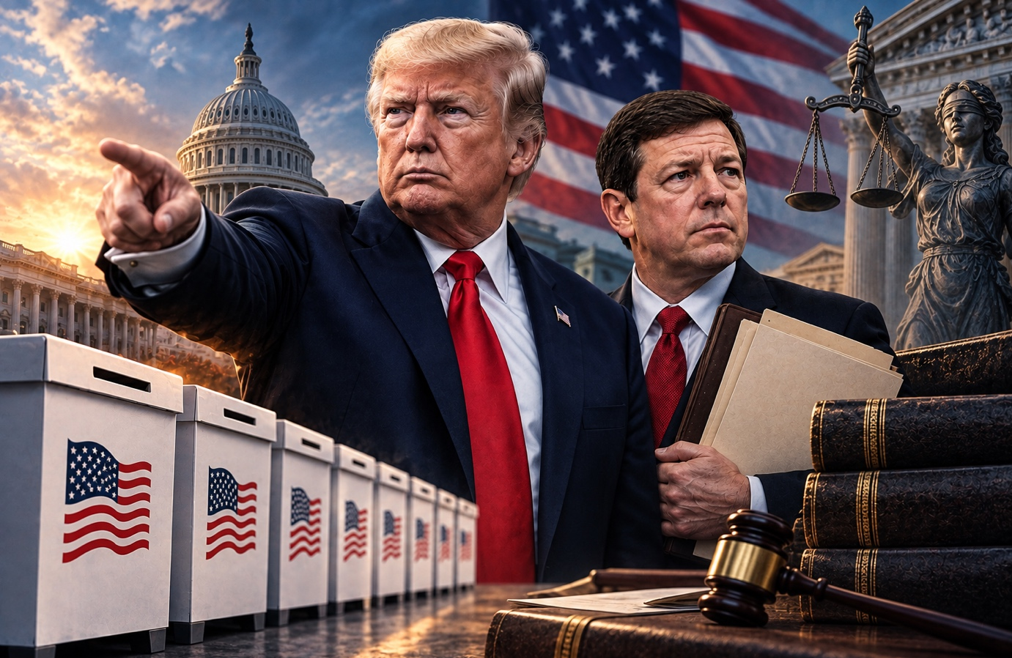
For Donald Trump, the battle for the mid-term elections begins long before polling day. Voter registers are to be checked for unauthorised registrations, the postal voting process is to be made more secure, and controversial electoral rules are to be clarified in court before the vote takes place.
For this legal offensive, Trump is relying on one of his long-standing supporters: his former pardon lawyer, Ed Martin. Martin’s career also illustrates a principle that Trump has pursued since his return to the White House: he does not forget who stood by his side in difficult times.
On 3 November, Americans will decide the majorities in Congress in the midterm elections [1]. There is a great deal at stake for Trump. If the Republicans lose their narrow majorities, the final two years of his presidency could become considerably more difficult. Accordingly, the battle over the electoral rules has begun early.
Voter registers, the eligibility of non-citizens to vote and postal voting are under particular scrutiny. The US Department of Justice is attempting to obtain detailed voter data from numerous states. The government also wants to cross-check state electoral registers against federal data to identify individuals who may not be eligible to vote.
Tightening the rules on postal voting
At the same time, Trump is attempting to tighten the rules on postal voting. Under his administration’s plans, voter data is to be cross-checked more thoroughly and the delivery and processing of postal voting materials made more traceable.
Some of these measures are already at the centre of legal disputes. Courts have restricted or blocked the government’s plans. The battle over the mid-term elections is thus already being fought in court weeks before the actual polling day.
For this very battle, Trump is now relying on a man who is well versed in political and legal turf wars.
Stopping electoral fraud
Ed Martin is leaving his post at the US Department of Justice for this role. Trump personally announced that Martin would, from now on, lead the legal battles surrounding the mid-term elections and subsequently the 2028 presidential election from outside the government. His mission is to fight for what the Trump movement considers to be “free, fair and secure elections”.
Martin is not starting from scratch. Even as acting US Attorney for Washington, he dealt with issues of electoral integrity. Where Republicans suspect breaches of electoral law or inadequate safeguards, the courts are to rule on the matter before millions of votes are cast and counted.
This is based on experiences from the 2020 presidential election. Trump continues to maintain his claim that the election was stolen from him through fraud. However, no evidence of widespread electoral fraud that would have altered the result in Joe Biden’s favour was found in the subsequent legal proceedings. For the MAGA movement, however, the dispute had a lasting consequence: it does not want to wait until after an election to contest the rules in future.
The Trump administration wants to determine whether the electoral rolls include people who are not eligible to vote. This concerns, in particular, possible registrations of non-citizens. To carry out such checks, data from various government sources is to be cross-referenced.
Absentee voting is also to be scrutinised. Trump has been pushing for stricter rules and better oversight mechanisms for years. His administration is now attempting to push through such measures before the mid-term elections. Here, too, the focus has shifted from political rhetoric to specific legal challenges and the question of what powers Washington holds over the individual states.
Martin’s role lies precisely at this intersection. Rather than levelling allegations the day after the election, potential vulnerabilities are to be identified, documented and, where necessary, challenged in court beforehand. The legal preparations are thus becoming part of the election campaign in their own right.
Leaving no one behind
It is no coincidence that Trump has entrusted this task to Ed Martin of all people. Martin has been part of the MAGA movement’s political circle for years and stood by Trump even during those years when a return to the White House was by no means certain.
During the Biden administration, Martin represented defendants in connection with the events of 6 January 2021. Following Trump’s election victory, this loyalty was not forgotten. Trump first appointed him acting US Attorney for Washington and later as the Pardon Officer at the Department of Justice.
There, Martin adopted “No MAGA left behind” as his motto. The idea behind this was that, following the change of government, it was not only prominent supporters who should be considered. Ordinary protesters and activists who had been convicted in connection with 6 January should not be forgotten either.
Trump pardoned or commuted the sentences of numerous J6 convicts. Pro-life campaigners who had been convicted under the FACE Act were also pardoned. Martin referred to this as the “Year of Trump Mercy”.
At the same time, he investigated the political instrumentalisation of state authorities. At the Department of Justice, he temporarily headed the “Weaponisation Working Group”, which was tasked with investigating whether the state apparatus had been deliberately used against political opponents under previous governments.
A remarkable common thread thus runs through Martin’s rise. He stood by the Trump movement whilst it was in opposition; after the change of government, he looked after people who, from the MAGA movement’s perspective, had been politically persecuted; and he is now tasked with ensuring that legal disputes surrounding the next elections do not begin only after the votes have already been counted.
What the AfD could learn from this
The American electoral system cannot simply be transposed to Germany. The responsibilities are different, as are the rules governing voter registration and postal voting. What is interesting, however, is the strategy of taking potential disputes over the integrity of an election seriously before Election Day.
If there are concrete indications of irregularities, these can be documented at an early stage and examined from a legal perspective. Political parties, too, can professionalise their election monitoring, prepare their own election officials for potential problems and ensure that contentious legal issues do not only come to light once the result has already been determined. Those who wish to prevent manipulation, in particular, are reliant on robust evidence, trained observers and proceedings initiated in good time.
For the AfD, however, a second aspect of the American example is likely to be of interest. Upon his return, Trump is not relying exclusively on newly appointed officials, but is also entrusting responsibility to long-standing allies. Martin is a good example of this. He was already part of the conservative movement when the offices and roles he now holds were not yet on the horizon. Later, he represented people associated with the movement at a time when doing so was politically unwise.
Following the election victory, he was initially given responsibility within the Department of Justice. Now, ahead of the mid-term elections, Trump is entrusting him with one of the most politically sensitive tasks. This conveys a message that extends far beyond American electoral politics: following a success, a political movement should not forget those who carried it through the difficult years.
For the AfD, which is taking on government responsibility for the first time, this would be a highly relevant lesson. A party is sustained not only by its leading politicians, but also by the people who support it even when there are no posts, offices or social recognition to be gained from doing so. Not losing sight of these early supporters following a change of power is also part of Trump’s recipe for political success.
Ed Martin embodies both sides of this principle. Under the slogan ‘No MAGA left behind’, he initially focused on coming to terms with the past few years. Now he is tasked with ensuring that the next major confrontation does not begin only after election day. For Trump, loyalty to his own supporters and preparing for the next political battle clearly go hand in hand.